
Almost every California workers’ compensation case ends the same way, with a settlement. And yet, despite almost every case ending this way, it can be one of the most confusing and mystifying parts of the entire process. If you do a Google search, or look up workers’ compensation settlements with your favorite AI search tool, you will very likely learn the difference between a Compromise and Release and Stipulations with Requests for Award. And while it is important to understand these two differences, I have written this guide as a way of fully explaining workers’ compensation settlements. My goal with publishing this information is to empower injured workers like yourselves.
This guide walks through all of it in plain language: the two settlement types, where your rating number actually comes from, when to settle and when to wait, how denied cases resolve differently, why Medicare can freeze your case for months, what happens if you collected EDD, and how long it takes to get paid. I’m Ryan Kayrell, and I represent injured workers in Irvine and throughout Southern California. These are the questions I answer most often.
What Are the Two Ways a Workers’ Comp Case Can Settle?
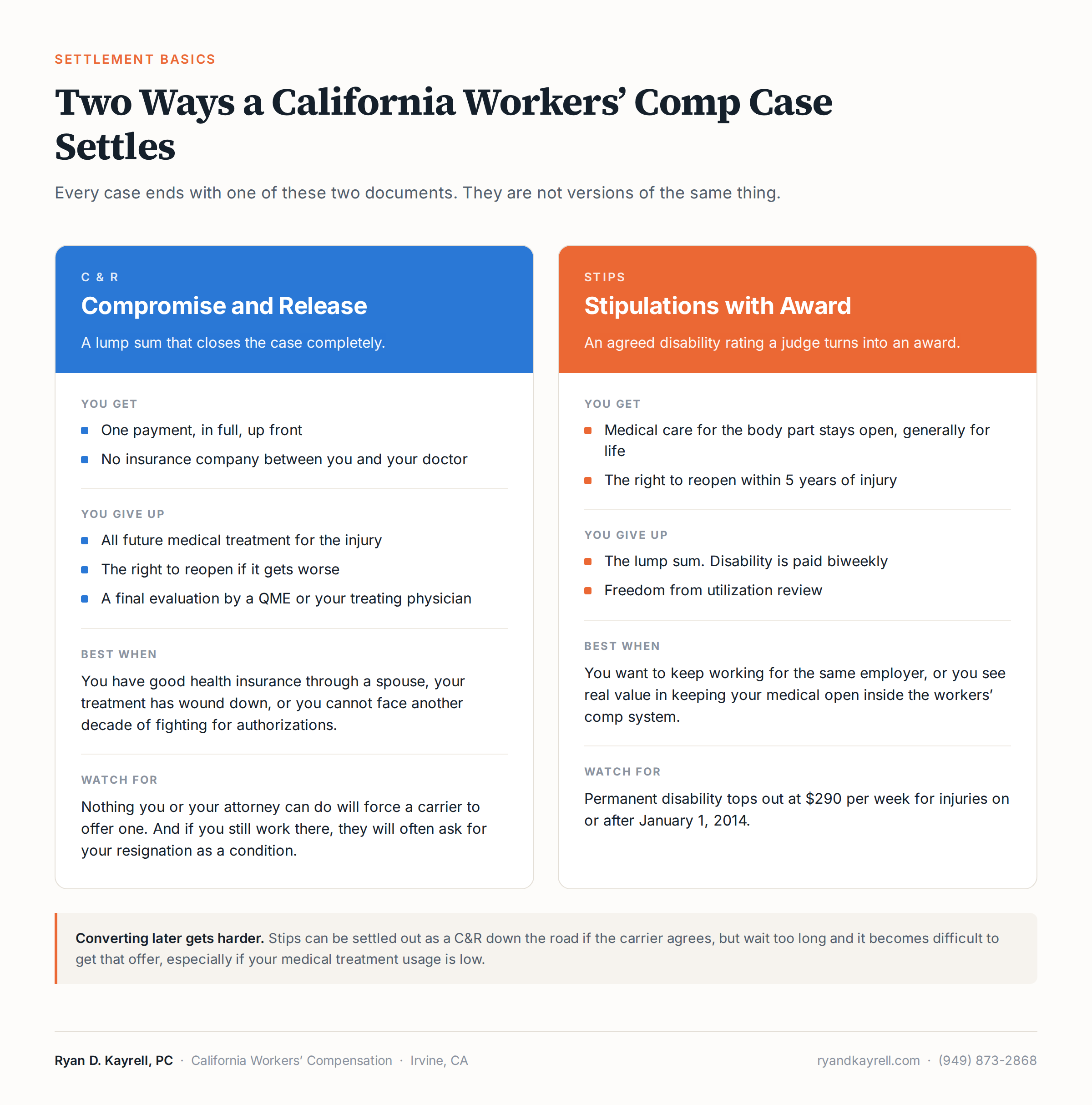
California gives you two settlement documents: a Compromise and Release, or Stipulations with Request for Award. They are not two versions of the same thing. They resolve different things and leave you in very different positions.
What Is a Compromise and Release?
A Compromise and Release, almost always called a C&R, is a lump sum settlement that closes your case completely. One number, one payment, done.
In a C&R you give up:
- Your right to future medical treatment for the injury. From the day the judge approves it, treatment is on you and your own health insurance.
- Your right to reopen the case if the injury gets worse later.
- Your right to have a final evaluation by a QME or your treating physician.
In exchange you get money now, in one piece, with no insurance company standing between you and your doctor ever again.
Most California workers’ comp cases resolve by C&R. It is also optional for both sides. The insurance company does not have to offer one, and there is nothing you or your attorney can do to force the insurance company into offering a C&R. Also, if you still work for the same employer, they will frequently condition offering the C&R on your resignation. That is a negotiated term, not a legal requirement, but it comes up constantly.
What Are Stipulations with Request for Award?
Stipulations, usually called Stips, are an agreement on your permanent disability percentage that a judge turns into an award.
With Stips:
- Your permanent disability is paid out over time in biweekly checks rather than as a lump sum, with credit for any PD advances the carrier already sent.
- Your medical treatment for that body part stays open, generally for life, still administered by the workers’ compensation insurance company and still subject to utilization review.
- You keep the right to file a Petition to Reopen if your condition genuinely worsens, so long as you file within five years of your date of injury.
Stips can be converted into a C&R later if you change your mind and the carrier agrees. But wait too long, and it may be extremely difficult to convince the insurance company to offer a C&R, especially if your medical treatment usage is low.
Which One Is Right for You?
The deciding question is what open medical treatment is actually worth to you.
Stips tend to fit when you want to continue your employment with the same employer where you were injured, or where you believe there is real value in keeping your medical open within the workers’ compensation system.
A C&R tends to fit when you have good health insurance through a spouse, or your treatment has essentially wound down, or you have spent two years fighting for every authorization and cannot face another decade of it.
Money matters too. Permanent disability under Stips is paid at a maximum of $290 per week for injuries on or after January 1, 2014, a rate that has not increased since. A C&R hands you a number today.
This is a personal decision with both a financial and a medical side, and it deserves a real conversation. What I do for clients is fully explain both options, go through the pros and cons of each, and then listen to them to determine what matters most for that particular client.
What Is Whole Person Impairment and Where Does Your Rating Come From?
Whole Person Impairment, or WPI, is the percentage a doctor assigns to describe how much function your body permanently lost. It is the number that drives the benefit called permanent disability in your case, and most injured workers never have it explained to them.
Where the WPI Number Comes From
California requires doctors to rate impairment using the AMA Guides to the Evaluation of Permanent Impairment, Fifth Edition. That book has been the required standard since 2005, and Labor Code section 4660.1 keeps it in place for injuries on or after January 1, 2013.
Once you reach permanent and stationary status, your QME or treating doctor examines you, measures things like range of motion, strength, and neurological findings, locates the applicable chapter and table in the Guides, and assigns a WPI percentage.
Here is the distinction that trips up almost everyone: WPI is not your permanent disability percentage. WPI is the raw medical number. Permanent disability is what that number becomes after the rating adjustments get applied.
How Does WPI Become a Permanent Disability Percentage?
Four steps convert a WPI number into the PD percentage that actually determines your money.
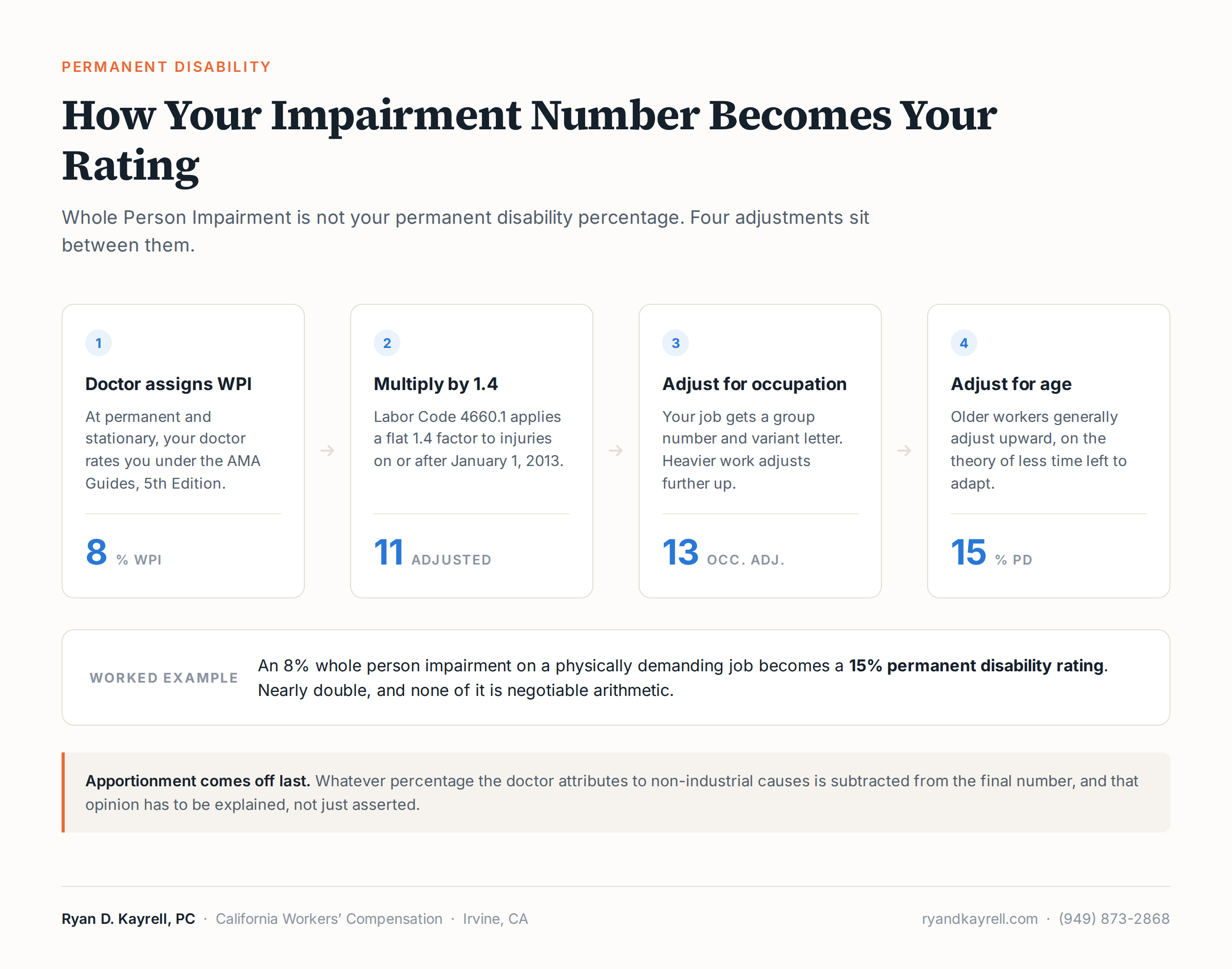
- The 1.4 modifier. For injuries on or after January 1, 2013, Labor Code section 4660.1 multiplies your WPI by an adjustment factor of 1.4. An 8% WPI becomes 11.
- The occupational adjustment. Your job gets assigned an occupational group number and a variant letter. Physically demanding work receives larger upward adjustments. A warehouse worker and a desk worker with identical 10% lumbar WPI do not end up with the same permanent disability.
- The age adjustment. Older workers generally receive larger adjustments, on the theory that they have less working life left to adapt to the limitation.
- Apportionment comes off. Whatever percentage the doctor attributes to non-industrial causes is subtracted. This is where a great deal of value quietly leaks out of cases, and I wrote about it in detail in Causation vs. Apportionment.
How Do You Read Your Rating String?
Your rating appears in your file as a string of numbers that looks like this:
15.03.01.00 - 8 - [1.4]11 - 340G - 13 - 15
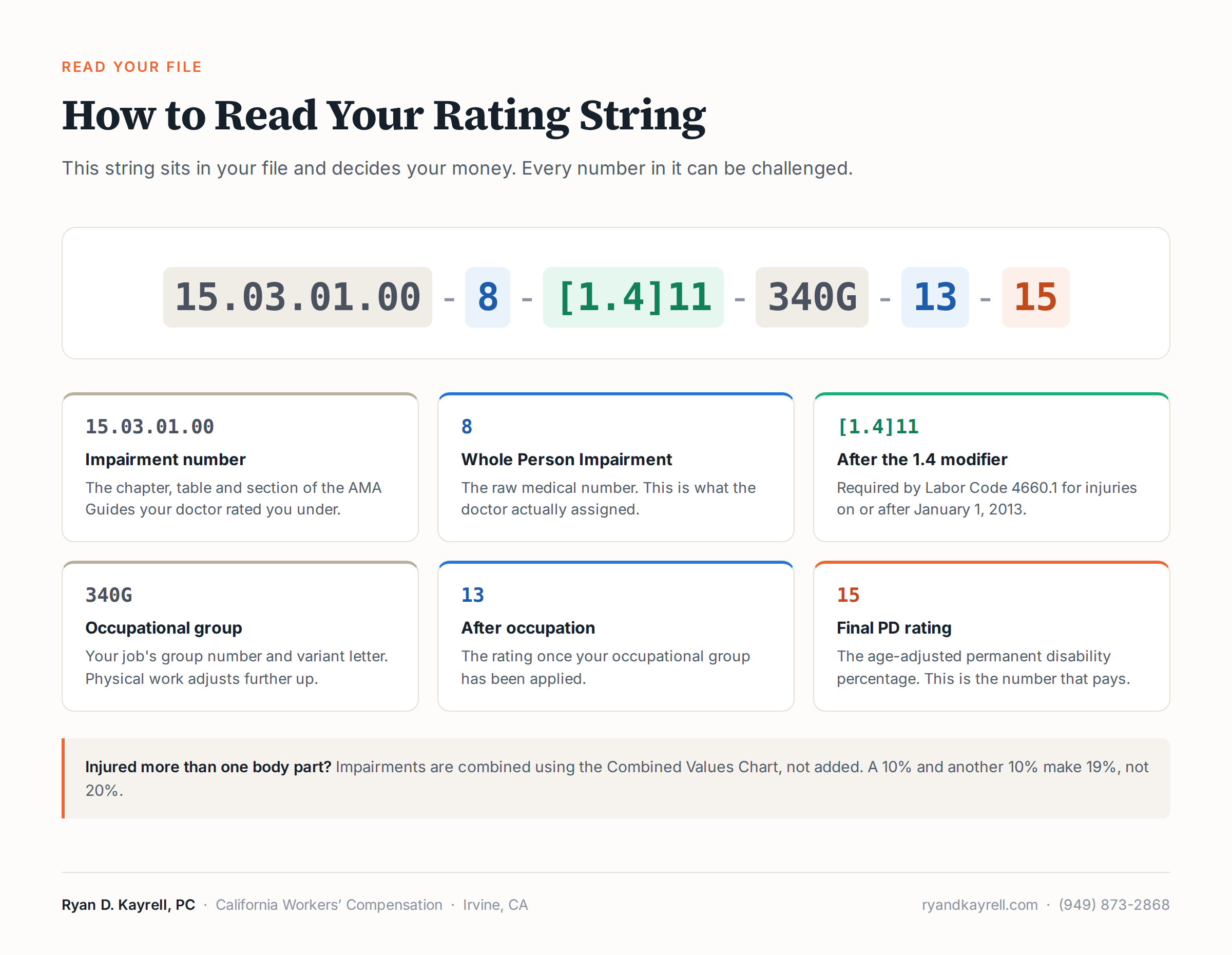
Read left to right, it says:
- 15.03.01.00 is the impairment number, identifying the particular part of body and injury. In this example, 15.03.01.00 is Lumbar – Diagnosis-related estimate
- 8 is your whole person impairment
- [1.4]11 is your WPI multiplied by the 1.4 modifier
- 340G is your occupational group and variant
- 13 is your rating after the occupational adjustment
- 15 is your final permanent disability percentage after the age adjustment
If nobody has walked you through your own rating string, ask. Every number in it is contestable.
What Happens When You Injured More Than One Body Part?
Multiple impairments are combined using the Combined Values Chart, not added together. This surprises people and it is not in your favor.
A 10% impairment and another 10% impairment do not make 20%. Under the Combined Values Chart they make 19%. Use the chart in section 8 of the 2005 Permanent Disability Rating Schedule, which is the officially adopted version, rather than the one printed in the AMA Guides.
Why Do Two People with the Same Injury Get Different Ratings?
Because a WPI number involves far more judgment than the word “rating” suggests, and because two doctors reading the same book can land in different places.
For example, if you have a low back injury, the QME doctor may rate your impairment using the Diagnosis-Related Estimate (DRE) method. For a typical low back injury, Category 2 of the DRE method allows the doctor to assign between 5 and 8% WPI. Different doctors are going to assign differing amounts within that range. Knowing which doctor is going to provide a better result is one reason to hire an experienced workers’ compensation attorney.
What Is Your Permanent Disability Percentage Actually Worth?
Your PD percentage converts to a fixed number of weeks of payments under Labor Code section 4658, paid at your PD rate. A concrete example would be of most benefit here.
Let’s go back to our rating string above. In this example, the QME assigned 8% whole person impairment for the lumbar spine using the diagnosis-related estimate method. After doing the permanent disability rating, the 8% whole person impairment adjusted to 15% permanent disability. If this were an injury occurring after 2013, this would entitle our injured worker to 50.50 weeks of permanent disability paid at a rate of $290 per week for a gross amount of $14,645.00.
This is exactly why the medical-legal work on your rating matters. A weak or incomplete WPI is the single most consequential document in your case, and it is attackable through a supplemental report, a deposition of the doctor, or an additional panel in a different specialty.
When Should You Settle Your Case?
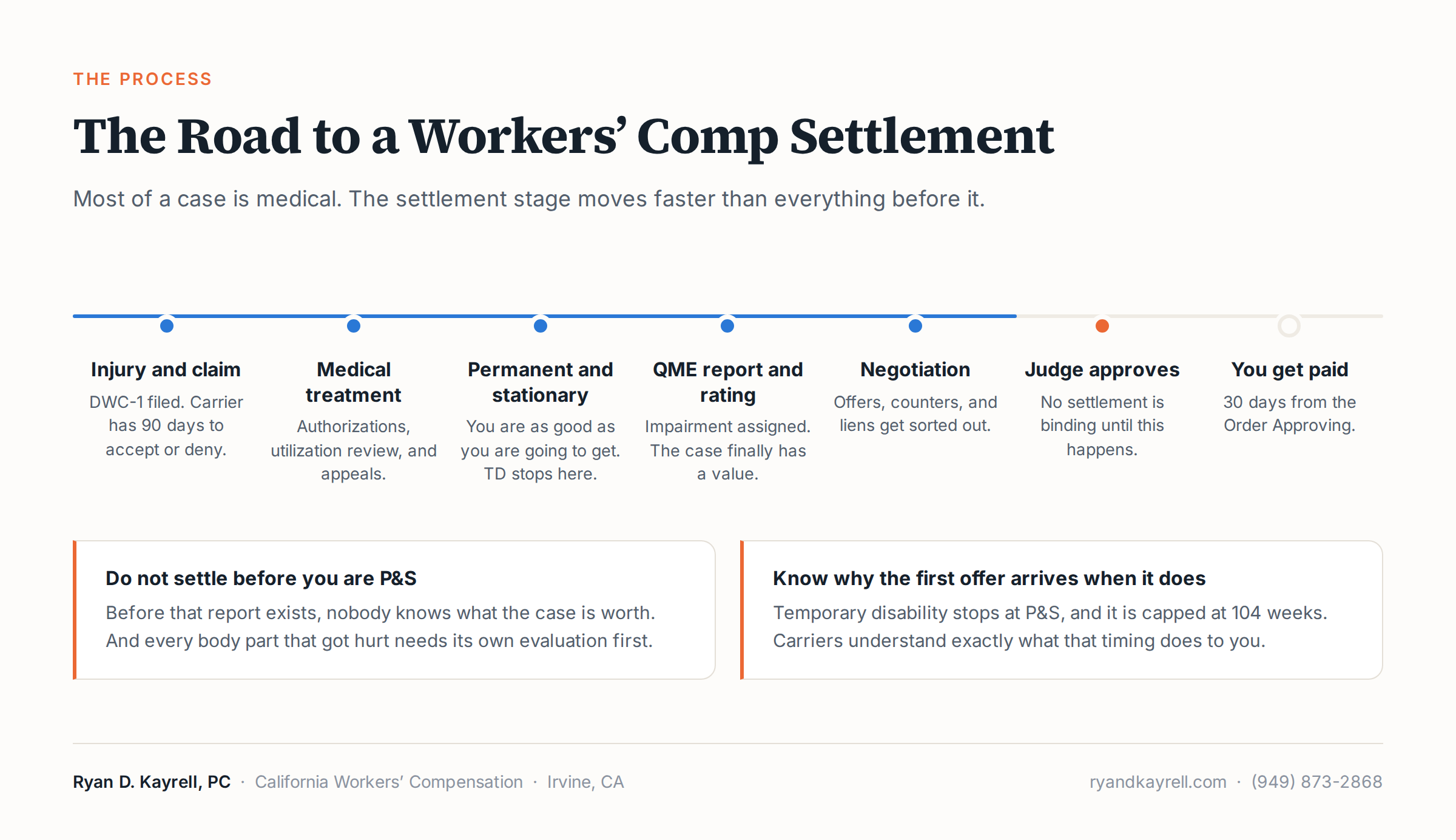
In almost every case you should settle after your doctor declares you permanent and stationary, and not before.
Why You Usually Wait for Permanent and Stationary
Permanent and stationary, sometimes called maximum medical improvement, is the point where you are as good as you are going to get.
Before a P&S report exists, nobody knows exactly what the case is worth. Sure, the parties can guess or estimate, but whole person impairment has not yet been assigned. Future medical care has not been described. Whether surgery is on the table is unresolved, and a surgery recommendation sitting in a report raises case value substantially even for clients who have no intention of having it.
Settling before a final report exists means guessing. And by final report, I mean a report or reports that describe all your injured parts of body. Do not settle a case until everything that got hurt has been evaluated by someone qualified to evaluate it, across every relevant specialty.
When Does Settling Early Make Sense?
Sometimes!
A denied claim you might lose. If compensability is genuinely in doubt and the medical evidence is thin, a certain settlement today can beat a coin flip eighteen months from now. That is a risk calculation, not a shortcut. If your claim is denied, definitely seek the advice of a qualified attorney to not only help with assessing the value of the case early on in the litigation process, but to also help make recommendations on whether the case should be litigated.
You need to be finished. Some people are done. They have a job offer out of state, they are carrying debt that compounds, or the case itself has become part of what is making them worse. A case that drags on for years carries a cost that never shows up in the settlement math, and it is fair to weigh it.
Small value, capped exposure. On a low-impairment claim where future medical amounts to a few visits a year, waiting nine months to gain a small amount can be a bad trade.
How Is Settling a Denied Case Different From an Accepted One?
A denied case can only settle by way of Compromise and Release. The value of that settlement is driven by potential case value and litigation risk. An accepted case has both settlement options and a number driven by your rating and need for future medical treatment.
Settling an Accepted Claim
Liability is not in dispute. The insurance company has admitted the injury is work related and has been paying for treatment and disability benefits.
Both doors are open. You can do Stips, you can do a C&R, and you can negotiate between them. What remains to argue about is impairment, apportionment, the value of future medical care, and unpaid benefits. The fight is about how much, not whether. Good attorneys on both sides should be able to reach a consensus on the value of the case.
Settling a Denied Claim
Denied means the insurance company says this is not their injury at all. Maybe they dispute that it happened at work, maybe they dispute that the injury exists, maybe they are raising an affirmative defense.
On a denied claim the settlement is almost always a C&R. Stips presume an admitted industrial injury with an agreed permanent disability, and a carrier denying the claim will not agree to that. So a denied case resolves as a lump sum with express language that the insurance company admits nothing.
The number reflects risk rather than rating. Nobody is calculating your permanent disability. Both sides estimate a potential case value, the cost of going to trial, and the likelihood of a successful case. A strong denial with a favorable QME report on causation and clean facts can settle for real money. A weak one settles for a fraction of what the same injury brings on an accepted claim.
Which is why the medical-legal work on a denied case matters enormously. The QME report on causation can move the needle. Getting the right specialty on the panel, striking the right doctor, and making sure the doctor receives complete records, are the things that move that number, and all of it happens long before anyone discusses settlement.
One more thing worth saying. A denial is not the end of the case. Denials get reversed, and a denied claim that later gets accepted is a very different case.
What Is a Medicare Set-Aside and Why Does It Slow Everything Down?
A Workers’ Compensation Medicare Set-Aside, or MSA, is a portion of your settlement carved out and earmarked for future injury-related treatment that Medicare would otherwise pay for. It is the single most common reason a settlement takes months longer than expected.
What an MSA Actually Is
Medicare is a secondary payer. When a workers’ comp case settles and closes out future medical care, the federal government does not want to pick up the tab for treatment the insurance company should have covered. So a portion of the settlement is set aside, you spend it on injury-related care first, and Medicare steps in once it is properly exhausted.
The money is still part of your settlement. It just comes with conditions. It must be spent on injury-related treatment Medicare would cover, the spending has to be tracked, and you report it annually. It arrives either as a lump sum or as an initial seed amount plus annual deposits funded through an annuity.
When Does an MSA Apply to Your Case?
An MSA becomes a live issue if you are already enrolled in Medicare, or if you are reasonably expected to enroll within about 30 months.
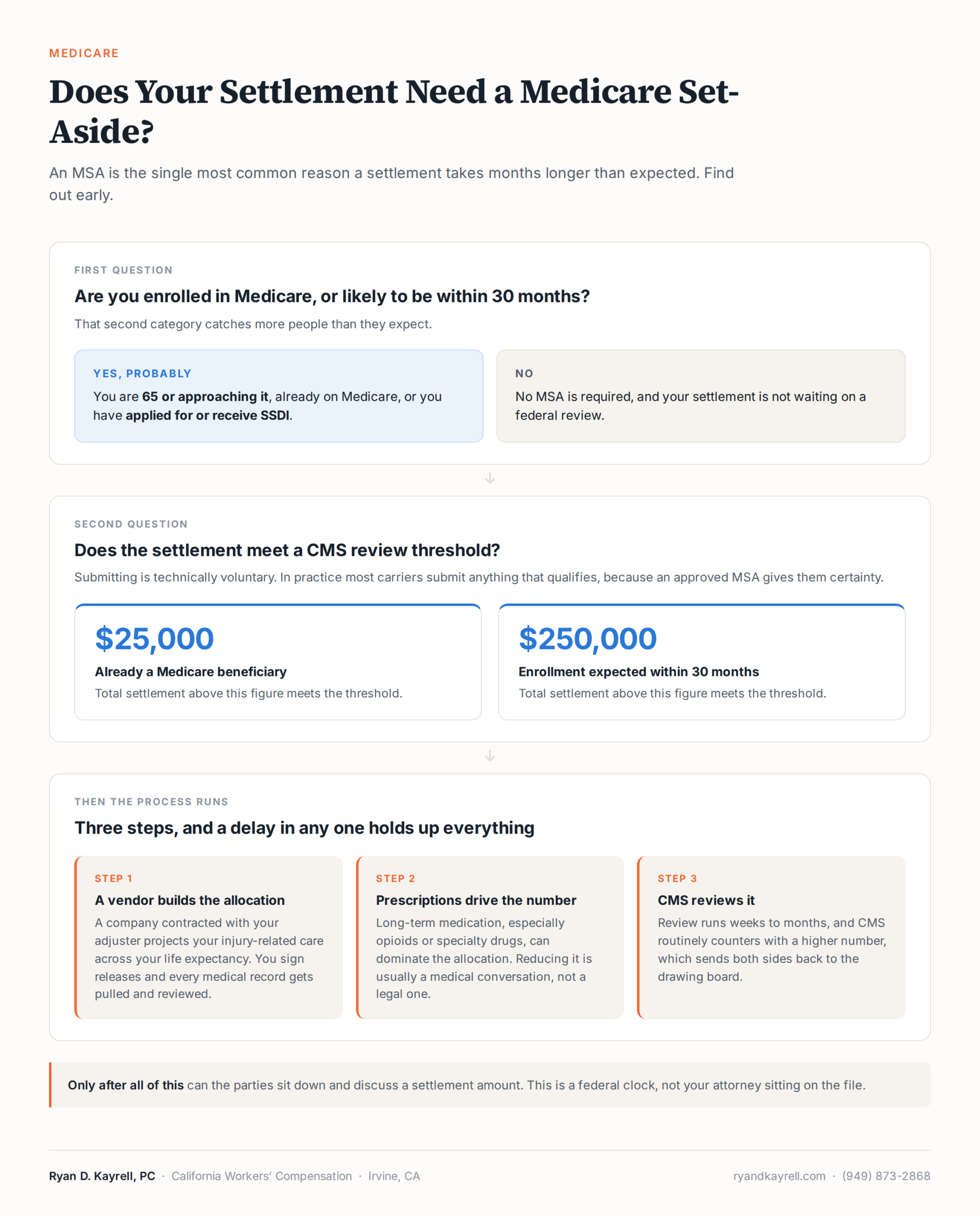
That second category catches more people than they expect. It includes anyone approaching 65 and anyone who has applied for or is receiving Social Security Disability.
If you are 62 or older, or you have filed for SSDI, raise this at the very start of settlement discussions. Discovering it late just slows everything down even more.
Why Does It Take So Long?
The MSA process has multiple steps, and any delay in the process holds everything up. Typically the process looks like this:
A vendor has to build the allocation. A company contracted with your adjuster prepares a report projecting your injury-related treatment across your life expectancy, which requires complete medical records, a full payment history from the carrier, and detailed prescription information. Assembling it takes weeks, and gaps send everyone back to the start. You will be required to sign releases, and all of your medical records will need to be obtained and reviewed.
Prescriptions drive the number. Long-term medication, especially opioids or expensive specialty drugs, can dominate an MSA allocation. Sometimes the most effective way to reduce an MSA is a documented change in the treatment plan, which is a medical conversation rather than a legal one.
CMS takes its time. After the MSA report is prepared, it is submitted to CMS for review. Submitting is technically voluntary, and CMS says plainly that no statute requires it, but most carriers submit anything that meets the review thresholds because an approved MSA gives them certainty. CMS will review when either of these is true:
- You are already a Medicare beneficiary and the total settlement exceeds $25,000
- You are reasonably expected to enroll in Medicare within 30 months and the total settlement exceeds $250,000
Review runs weeks to months, and CMS routinely counters with a higher number, which sends the parties back to the drawing board.
Only once all of this has taken place are the parties even able to sit down and have a discussion on the settlement amount. None of this is your attorney sitting on your file. It is a federal process running on a federal clock.
What Happens If You Collected EDD?
If you collected state disability or unemployment while your comp case was pending, EDD gets a lien against your settlement, and the settlement documents have to say who pays it.
This comes up constantly, especially on denied and delayed claims where EDD is the only money coming in.
California law lets EDD claim a lien for state disability benefits paid during a period when it was unclear whether workers’ comp owed you temporary disability, and for unemployment benefits paid for days you were also entitled to temporary disability. The rule exists to stop you from being paid twice for the same weeks.
Two things to watch:
EDD has to be resolved prior to submitting the C&R for approval. EDD has special status before the WCAB. Their lien has to be addressed in the settlement documents. Since having an EDD lien count against the settlement is a hurdle to settlement, most times Defendants will agree to resolve the EDD lien at or before the settlement. The disposition of the EDD lien is stated in the C&R or in an attached document called Defendant’s Affidavit regarding Resolution of Liens.
Tell your attorney early. Collecting EDD is a normal fact of a normal case. It only becomes a problem when it surfaces at the end, after the numbers were built without it.
Medical providers, child support arrears, and health insurers can also assert claims against a settlement. Every one of them should be identified prior to signing the settlement documents.
Don’t Let the Voucher Get Settled Away
If you have permanent disability and your employer does not offer you suitable work after you go permanent and stationary, you are entitled to a Supplemental Job Displacement Benefit voucher worth $6,000, plus a separate $5,000 state Return-to-Work Supplement. That is roughly $11,000 with nothing to do with your settlement amount.
Plenty of adjusters never issue it. And a broadly written C&R can release it along with everything else.
Ask for the voucher explicitly and make sure the settlement documents address it rather than quietly sweeping it up. Then actually use it, which is its own project with its own deadlines. I wrote two full walkthroughs on this: The Injured Worker’s Ultimate Guide to the Voucher covers eligibility and what the voucher pays for, and You Got a Workers’ Comp Voucher. Here’s How to Actually Use It. walks through the fastest ways to get the money.
The Return-to-Work Supplement carries a hard one-year deadline from the date you receive the voucher. Miss it and the $5,000 is gone.
How Does a Workers’ Comp Settlement Get Approved?
A California workers’ compensation settlement is not binding until a workers’ compensation judge approves it. Signing the settlement is the first step toward approval.
The Labor Code requires the WCAB to review every settlement. The judge reviews the settlement for adequacy, meaning whether it is reasonable given the medical evidence and the benefits at stake.
The process runs like this:
- The documents get signed. A C&R or Stips form, plus any addenda.
- They go to a judge. Sometimes at a Mandatory Settlement Conference, where a judge can review and approve on the spot. Sometimes by filing through EAMS. Sometimes by walk-through at the district office, which is generally fastest.
- The judge reviews it. They examine the medical reports, the permanent disability rating, benefits already paid, the liens, and the attorney fee.
- You get an Order Approving, or an Order Suspending. Approval arrives as an Order Approving Compromise and Release or an Award on Stips. An Order Suspending Approval is not a rejection. It usually means the judge wants an explanation. It gets fixed and resubmitted.
Timing varies by district office and submission method. A walk-through can be same day. A filed submission generally runs a few weeks.
When Do You Get Paid After a Settlement?
Once a judge signs the Order Approving your C&R, the insurance company has 30 days to pay. Not 30 days from when you signed, but 30 days from the order. Or even more specifically, 30 days from the date the Order was served on the Defendant.
Payment usually lands inside that window, often before it closes.
If the carrier misses it, interest runs on an unpaid award under Labor Code section 5800, and a penalty is available under section 5814 for unreasonable delay in paying compensation, including settlement money. Carriers know this, which is a large part of why late payment on an approved C&R is fairly rare.
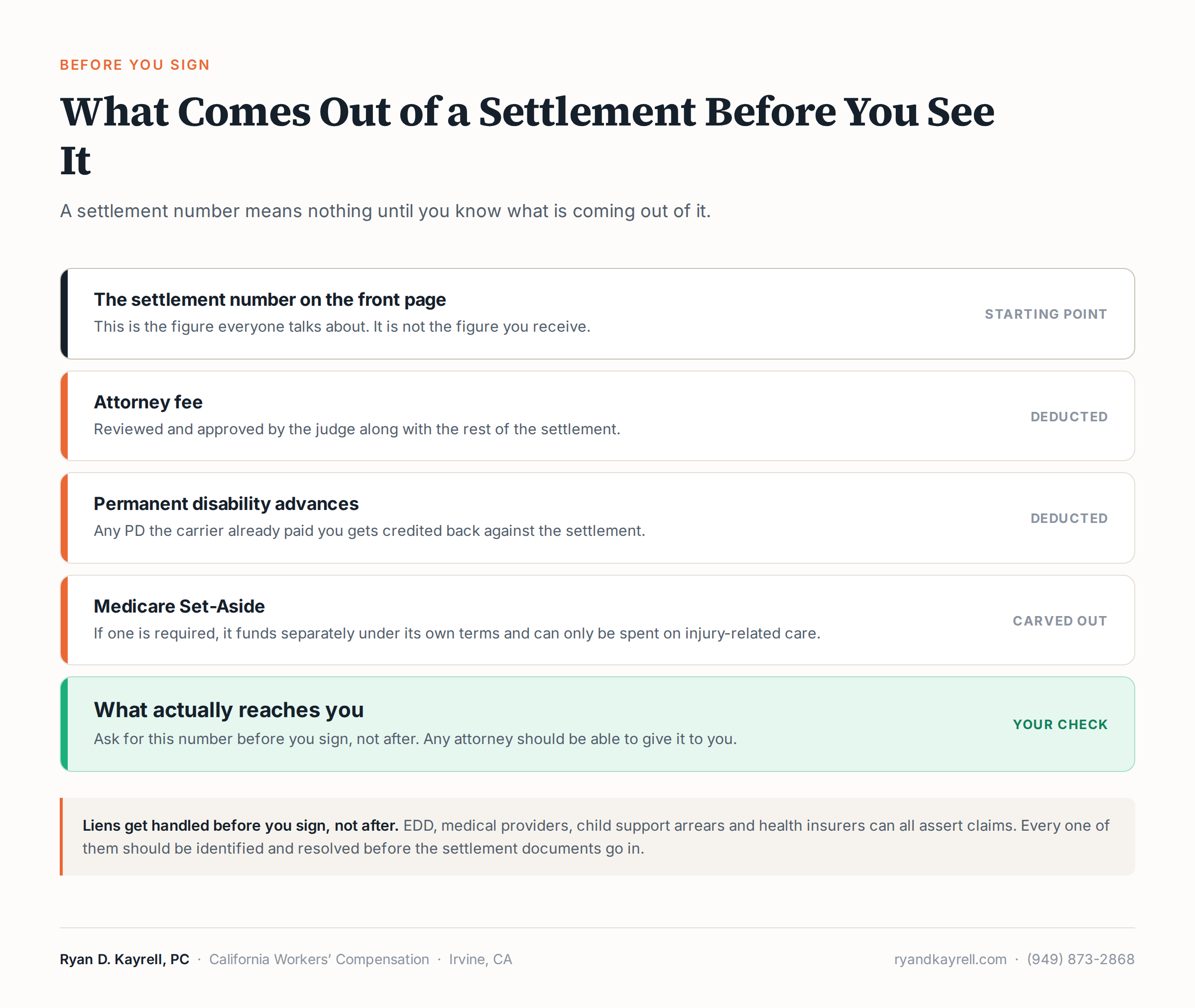
What arrives is the settlement amount minus the pieces that were always coming out: the attorney fee, permanent disability advances already paid, and the MSA if there is one, which typically funds separately under its own terms.
Stips work differently. There is no lump sum. Permanent disability begins flowing in biweekly payments with credit for advances already made from the date agreed upon in the Stips, and your medical treatment stays open going forward.
A few practical notes. Workers’ compensation benefits and settlements are generally not treated as taxable income under federal law, though if you also collect Social Security Disability there is an offset wrinkle worth raising with an accountant. Make sure the carrier has your correct current address, because checks do get mailed to old ones. And if you are past 30 days with nothing, call your attorney rather than waiting it out.
Deadlines You Need to Know
| Deadline | Time limit |
|---|---|
| Insurer pays an approved C&R | 30 days from the Order Approving |
| Petition to Reopen for new and further disability | 5 years from date of injury |
| Employer must offer suitable work to avoid the voucher | 60 days from the P&S report |
| Insurer must issue the voucher after no offer | 20 days |
| Voucher remains usable | 2 years from issue, or 5 years from date of injury, whichever is later |
| Return-to-Work Supplement application | 1 year from receiving the voucher |
The Bottom Line
The settlement stage is where a workers’ comp case stops being about doctors and starts being about numbers, and it moves faster than the two years that came before it.
A few things carry most of the weight:
- Understand what you are giving up before taking a lump sum, because closing out future medical is permanent.
- NEVER take the first offer!
- Know where your rating came from. WPI is the foundation of your PD rating.
- Do not settle before the case is ripe, which usually means a P&S report on every body part that got hurt.
- Find out early whether Medicare is in the picture, because that determines whether you are looking at three months or nine.
- Know what liens exist and who is paying them.
- Make sure the voucher is accounted for.
- Remember that no offer is real until a judge approves it, which means there is always time to ask a question before you sign.
Have a Settlement Offer in Front of You?
If someone has put an offer on the table and you cannot tell whether it is fair, bring me the offer and your medical reports and we will go through them together. I will run your case both ways, show you what the rating is actually worth, and tell you honestly whether the number makes sense. That conversation costs nothing, and there is no obligation.
Ryan D. Kayrell, PC
15615 Alton Pkwy, Suite 450, Irvine, CA 92618
Call: (949) 873-2868
Email: wc@ryandkayrell.com
Visit: ryandkayrell.com
This article is general information about California workers’ compensation and is not legal advice for your specific situation. Reading it does not create an attorney client relationship.